Seven to Eternity
The rot of all principles begins with placing a single foot on the road to compromise.
The rot of all principles begins with placing a single foot on the road to compromise.

Action Comics is finally addressing one of the more interesting plot points introduced in Rebirth, namely the co-existence of Clark and Kal as man and Superman, respectively.

Hitch’s ambition in addressing significant aspects of the mythology exceeds his skill as a storyteller… “The Extinction Machine” may well prove immensely consequential, but if few readers remain due to its dearth of quality, the ideas it establishes will not matter much in the minds of fans nor future writers alike.
Jurgens may be writing a smarter Superman than is often depicted, but he’s certainly not writing a smarter comic book than fans of the genre have grown accustomed to.
The “depressingly normal” Keisha is certainly not normal, but she is depressing, and is the major hurdle to enjoying a conceptually cool comic.
Since Saturnalia, solstice festivals such as Yule and Christmas have always been about the conquest of light over darkness, and long before comic books stories of heroes across all cultures have been about the same. Morrison’s genius is in making explicit a connection so obvious it’s easily overlooked; so simple it becomes sublime.

Seemingly opposite notions – the insignificance of man in the universe and the centrality of Earth’s premier paragons across spacetime – are both being displayed in Hitch’s Justice League.

Segovia’s otherwise gorgeous art unfortunately contributes to the derivative, uninspired storytelling which has plagued Action Comics throughout Path of Doom.
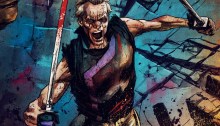
The Fist and the Steel does not maintain the high standard set by the Siege of King’s Castle, but its flashforward into Colin King’s future is full of intriguing information – quite appropriate for a series about espionage.

Justice League #2 is a marked improvement over the first, both for Bryan Hitch’s plotting and Tony Daniels’ pencils.
 The Hub City Review